
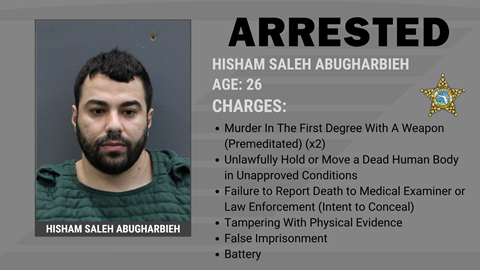
HILLSBOROUGH COUNTY — Prosecutors are laying out a detailed timeline of purchases, digital activity, and forensic findings as they seek to hold a man without bond in connection with the deaths of two University of South Florida doctoral students, Zamil Limon and Nahida Bristy.
In a motion for pretrial detention, the State argues the defendant should remain in custody, citing the severity of the charges—two counts of first-degree murder—and what prosecutors describe as extensive evidence of planning, cleanup, and attempts to conceal the crimes.
According to the filing, investigators traced a series of purchases and deliveries tied to the defendant in the days surrounding the victims’ disappearance on April 16, 2026. Records show that cleaning products and related items—including Lysol wipes, Febreze, and body wash—were ordered through a delivery service and picked up from a CVS location that same night.
Prosecutors say additional items linked to the case include heavy-duty black trash bags, fire starter materials, charcoal, lighter fluid, and duct tape. Some of these materials were later recovered during searches, including from a dumpster associated with the apartment complex where the defendant lived with one of the victims.
Inside that dumpster, investigators found multiple items of evidentiary value, including clothing, socks, slides, and a floor mat—many of which tested presumptively positive for blood. A wallet and personal belongings belonging to one of the victims were also discovered among the discarded items.
Detectives also documented significant blood evidence inside the apartment itself. According to the motion, multiple areas—including the hallway, kitchen, and the defendant’s bedroom—tested presumptively positive for blood. Investigators noted patterns consistent with smearing and cleaning, suggesting attempts were made to remove or conceal the evidence.
The motion further states that additional materials matching those recovered from the dumpster—such as heavy-duty trash bags—were located inside the defendant’s residence, including in his bedroom and bathroom.
Digital evidence also plays a central role in the State’s argument. Prosecutors say the defendant conducted multiple online searches in the days leading up to and after the victims’ disappearance. Among them were queries asking what happens if a body is placed in a garbage bag and thrown into a dumpster, as well as questions about disposing of bodies and whether a car could be cleaned or altered.
Additional searches referenced firearms and legal ownership, along with location-related queries tied to the area where evidence was later recovered.
Investigators also reviewed phone data and vehicle movements, which prosecutors say place the defendant traveling from the apartment complex to areas in Tampa and Clearwater during key timeframes. Surveillance footage and license plate reader data reportedly captured the defendant’s vehicle along routes including Fletcher Avenue, the Courtney Campbell Causeway, and Clearwater Beach.
The motion describes how at least one victim’s phone was tracked moving along a similar route before going inactive, while additional surveillance captured a figure consistent with the defendant in the Sand Key area.
Authorities later located the body of one victim near the Howard Frankland Bridge, inside multiple trash bags. An autopsy determined the death was a homicide caused by multiple sharp force injuries.
The second victim has not been located, but prosecutors say evidence collected—including blood found in the apartment and among discarded items—indicates she was also killed.
On Sunday, HCSO and PCSO recovered human remains in the area of I-275 and 4th Street N. Positive identification of the remains has not been determined at this time; the body is in the possession of the Pinellas County Medical Examiner’s Office.
Based on the totality of the evidence, prosecutors allege the defendant used a bladed weapon to kill both victims, then attempted to clean the scene, dispose of evidence, and conceal the crimes using materials he had purchased in advance.
The State argues these actions demonstrate not only a substantial probability of guilt but also a clear danger to the community. Prosecutors maintain that no conditions of release would reasonably ensure public safety or the integrity of the judicial process.
Alternatively, the State is asking the court to deny bond entirely, arguing the proof of guilt is evident, and the presumption is great under Florida law.
A judge will determine whether the defendant will remain in custody without bond as the case proceeds.